It's high time for Wisconsin to legalize it

Vol. 80
In This Issue: Essay | Now Read This | Take Action/Donate | Please Take My Survey! | Final Frame
This essay was originally published by The Recombobulation Area, part of the Civic Media Network, on Dec. 22. Since publication, there’s been a curveball thrown into the mix that only confuses this issue more: Donald Trump signed an executive order reclassifying marijuana from a Schedule I to Schedule III drug, potentially opening the door for federal-level legalization of medical use of the drug. How this will impact the debate in Wisconsin remains unclear, particularly around the hemp industry.
It’s time for Wisconsin to fully legalize hemp and marijuana. The clock is officially ticking.
You’d be forgiven if you’re confused that the mind-altering bud isn’t already legal in the state, at least in some capacity. Since 2018, a loophole in the federal Farm Bill has allowed for the production and sale of hemp-derived THC products, even in states (like Wisconsin) where cannabis products are still illegal. To clarify, hemp and marijuana are essentially two varieties of the same species of plant, cannabis sativa. Marijuana has 25% THC content or more and hemp has just 0.3% or less. THC is the psychotropic compound that gets you high.
A booming business of hemp-derived products has since sprouted in Wisconsin, accounting for an estimated $700 million a year in revenue and at least 3,500 jobs. Suddenly, thanks to the 2018 bill, you could walk into a bar and buy hemp THC-infused seltzers, or pick up gummies or salves from a local boutique.
That’s all under direct threat after a provision to effectively ban hemp-derived THC was slipped into the bill to reopen the government back in November. It sets a one-year timeline before taking effect. Nationally, that means a $28 billion industry supporting some 300,000 jobs is at risk of being decimated.
This may not feel all that important to you if you’re not someone who uses THC or CBD products, but the issue should concern us all. There are negative social, legal, and economic ramifications to such a ban, and it comes at a time when we should be moving towards overall legalization and regulation, rather than in the opposite direction.
There is some movement on this at the state level. Three different bills addressing the issue are coming down the pipeline in the state legislature. Unfortunately, two of the three would either codify the ban or impose impractical and onerous restrictions. The best bet (so far) appears to be a draft bill being circulated by state Sen. Patrick Testin (R-Stevens Point) that would keep hemp-derived THC legal, but with requirements for testing and certification, clear labeling, limits on dosage, and be limited for sale to those 21 and up.
This addresses the health and safety concerns that were the stated reason for the federal ban while providing a practical way forward for the industry. It’s ridiculous that a similar approach wasn’t taken at the federal level — but everything the MAGA-controlled Congress does these days is ridiculous. Our country also has a long history of overblown fear-mongering around all-things marijuana — the side effects of which includes a lack of good, long-term research on its effects and a lack of proper FDA oversight — both things that would go a long ways toward making the industry and its products safer for everyone.
Thanks to the shifting tides of political power in Wisconsin, there’s at least the chance to do better at the state level. Keeping the industry legal and well-regulated is good for consumers who have increasingly turned away from alcohol and are seeking alternatives. It would also help prevent the inevitable growth of a black market for these products, which is the other major effect of making something illegal that people want and/or rely on.
Testin’s bill would be a good first step to righting the ship, but more is needed. Instead of wrangling a needlessly complicated patchwork of laws and loopholes, why not just legalize recreational marijuana as well? Two-thirds of registered voters in Wisconsin support it, according to recent polling by the Marquette University Law School. The state is losing millions in tax and other revenue to our neighbors in Minnesota, Illinois, and Michigan where recreational and medicinal use are now legal. Why not apply the same common sense regulatory framework being proposed for the hemp industry to marijuana? There are plenty of important projects that would benefit from the tens of millions of dollars in tax and other revenue that would be generated by the industry. States with legal cannabis put the money generated toward a wide variety of civic and public initiatives, including restorative investments and, perhaps most importantly, reparations for communities that had previously been disproportionately impacted by drug enforcement actions.
This issue has always felt like such a gimme for lawmakers. Wisconsinites overwhelmingly want and support legalization. It’s a true job creator and revenue generator, at a time when both are greatly needed. Coupled with amnesty for everyone ever convicted of marijuana-related offenses and programs to ensure the industry remains largely locally owned and operated, it’s a win-win. And it’s gotta happen soon. If we’ve learned anything from the past year, it’s that we can’t wait for Congress to do the right thing.
Now read this.
“Fear and queer hunger in the Northwoods of Melissa Faliveno’s ‘Hemlock’”
I recently had the chance to chat with McFarland native author (and former Madison Roller Derby leaguemate) Melissa Faliveno on the eve of the publication of her first novel, which can best be described as a haunting queer forest noir about desire and transformation, all set in Wisconsin’s Northwoods. It was such a delight to talk with her about it and you can read my interview over at Tone now, which I hope you will! Then pre-order/pick up a copy of Hemlock when it drops on January 20, and come see Melissa give a book talk at Madison’s A Room of One’s Own bookstore on February 19.
“Wisconsin joins multistate lawsuit challenging youth gender care limits” [Wisconsin State Journal]
"Republicans are consistently trying to insert partisan politics and their political beliefs into personal medical decisions, and that’s a problem," Evers told the Journal Sentinel in an emailed statement. "Doctors and hospitals should be able to provide medically accurate care for their patients without fear of political retribution or criminal prosecution, and parents should be able to get their kids medical care when they need it. This is basic stuff."
“2 years after onstage cardiac arrest, local drummer plays on” [Wisconsin State Journal]
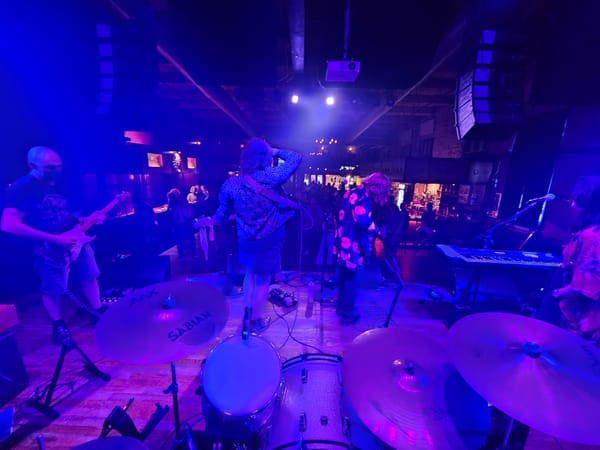
Rokker is a fellow Madison musician I’ve known for years, and who has always been an enthusiastic supporter of local music generally. I remember hearing about his onstage heart attack and the quick action of Gamma Ray bar owner Kevin Willmott II (also a friend) and other audience members that helped save his life. Since then, another beloved local musician (Rob Dz) also suffered a cardiac event on stage at Gamma Ray and was likewise saved by CPR at the scene. The bar is now raising funds to have an AED in the venue, something I hope catches on in more places.
I can’t recommend enough getting CPR/First Aid training, too, if you’re at all able. Makes a great New Years resolution! I get mine re-upped every year through my roller derby league and am grateful to have those skills everywhere I go, just in case. Check out class offerings from the Red Cross here.
“The casino-fication of news” [Popular Information]
Since the IPC declared there was a famine in Gaza in August, there are people who used Kalshi to profit from the starvation of other people.
“The emotional labor behind AI intimacy” [Michael Geoffrey Asia for Data Workers’ Inquiry - pdf]
Like many of us, I entered this work through subcontracting structures that deliberately obscure responsibility. The labor is fragmented, undervalued, and consistently portrayed as “simple,” even as it exposes workers to disturbing content and demands finely tuned emotional performance. These narratives of “low-skill” work hide a deeper reality: a rapidly expanding industry that relies on hidden human labor while offering minimal protections, unstable contracts, and little recognition.
Take Action.
Add your name to Clean Wisconsin’s petition to halt all new data center development in Wisconsin until the development of a “comprehensive state plan to ensure these projects will not harm our communities.” Sign here.
On another note, a dear friend sent along an appeal for year-end donations that I think is well worth passing along/your consideration:
In the summer of 2015, I tested positive for tuberculosis (TB) infection during a routine physical. Within a month, I started the newest and shortest course of antibiotics. The medications were unpleasant, but three months later I was done. A life free from TB didn’t cost me a dime.
TB is curable and the drugs used to treat it can cost just a few dollars per dose. Yet TB remains the world’s most deadly infectious disease. In 2024, more than a million people died from TB, largely because they lacked access to timely diagnosis and treatment.
In 2025, things got a lot worse: the Trump administration cut funding for USAID, PEPFAR, and the Global Fund. Almost half of global TB funding disappeared overnight. Modeling suggests that these funding cuts will result in 9 million more child TB cases and 1.5 million more child deaths from TB. Every one of those deaths is preventable.
All people with TB deserve access to the kind of care I received: timely, accurate diagnosis followed by evidence-based treatment. Access to the right care saves lives, and in many cases livelihoods as well. As Americans, we can still help that happen even as our government fails to do its part. So this is a request to consider ending 2025 with a gift to improve access to TB treatment in low- and middle-income countries.
...the American Friends of the International Union Against TB [is] a small NGO that supports the International Union Against Tuberculosis and Lung Disease by allowing Americans to make tax-deductible donations to its international efforts to fight TB. Donations through the American Friends this year are earmarked to support TB technical assistance and clinical training programs for high-burden settings. Even small donations can help support and expand the clinical workforce fighting TB in low- and middle-income countries, giving more people access to the right diagnosis and the right treatment at the right time. If you are able and feel so moved, you can donate online or choose one of the other options below.
To donate via the American Friends of The Union:
1.) Donate by check. Make the check to the American Friends of the Union and mail it to our treasurer at the following address:
American Friends of The Union
1441 Matthew Circle
Estes Park, Colorado 80517
Attn: Dr Max Salfinger
2.) Donate online. You can donate through our website, but this does have a 3% overhead cost: https://theunion.org/AmericanFriends
3.) Donate through a Donor Advised Fund. Just look for The American Friends of The International Union Against TB and Lung Disease, Charity ID # 87-3571602.
Survey time!
With the 80th edition of this newsletter, it occurred to me that I’d love to know what you think about it in a more direct way. I’d be so grateful if you’d take a few moments to fill out this quick survey with any feedback you have, ideas for future topics and/or features, questions you have, etc.
*** Fill out the survey here. ***
Regardless, my endless gratitude to each and every one of you who reads this! And here’s wishing you a safe and happy New Year. See you in 2026.
Finale frame.

Red-tailed hawk watching over a snowy field near my house, feathers poofed up against the cold. We seem to have a whole family of these guys hanging out.
‘Til next time.
Take care of yourself and each other. Rest well. Get ready. Abolish ICE. Free Palestine, Sudan, Congo, and everyone facing war, terror, and displacement.